Competitive Perception Upgrade: Continuously and Dynamically Input Market Signals into Brand Cognition, Insights Experiment of a Global Leading Automotive Brand
A global leading automotive brand utilizes GEA to continuously perceive website configurations, social media reputation, and sales feedback, analyzing competitive changes in real-time and updating sales scripts and comparison materials, compressing the dynamic response cycle from 5 days to within 8 hours, with an average lead conversion cycle shortened by 1.5 weeks.
Category
Date
2026-08-12
Read Time
3 min read
Competitive analysis in the automotive industry is a task that can never keep up with the pace.
A certain brand's marketing team spends a lot of time each week organizing competitive dynamics: crawling websites, reviewing releases, sorting social media, and holding meetings to align—by the time the weekly report is sent out, the information is already delayed by three to five days. What's more troublesome is that competitive changes are not just about pricing. Which model has quietly adjusted its configuration items, which feature's reputation has suddenly fermented on social media, what new changes have emerged in customer inquiries when they visit the store after a price drop—these signals are scattered across too many places, and relying on manual aggregation simply cannot keep up.
The result is: the marketing team works hard for a week, but the judgments received by sales are already outdated; valuable competitive signals are often noticed only two to three days after the competitors take action, and by the time they adjust their response strategy, another week has passed. This issue, this brand decided to run again with GEA.
Perception (Sense): GEA continuously scans three types of competitive signals, writing them into the Context System in real-time—changes in website configurations (which model adjusted which configuration item, pricing linkage logic), changes in social media discussions (consumer sentiment trends regarding competitive features, emotional polarity changes), and sales signals (frequency and focus shifts of customers mentioning competitors when they visit the store). These signals are not aggregated weekly but are updated in real-time and continuously accessible.
Reasoning (Reason): Comparing competitive dynamics with their own product configuration structure, marking the current dimensions of competitive pressure and the cost-performance advantages that can be amplified. It’s not a generalized statement of “competitors have lowered prices,” but rather: “This configuration item of this competitor has the greatest impact on our customer conversion rate within a certain price range, and it is recommended to actively compare it in sales scripts.”
Action (Act): The reasoning conclusions are directly connected to the sales side—sales scripts are updated in real-time according to competitive dynamics, and configuration comparison materials are refreshed on key dates (such as competitor price drops or new configuration releases) on the same day, so sales do not need to wait for weekly reports or remember last week’s meeting minutes.
Write Back (Write Back): Each dynamic update of competitors and the effectiveness of sales responses are consolidated into the Context System. Which types of competitive signals have the greatest impact on transaction conversion, and which types of script adjustments have the most obvious effects—these accumulated judgments make competitive intelligence increasingly precise.
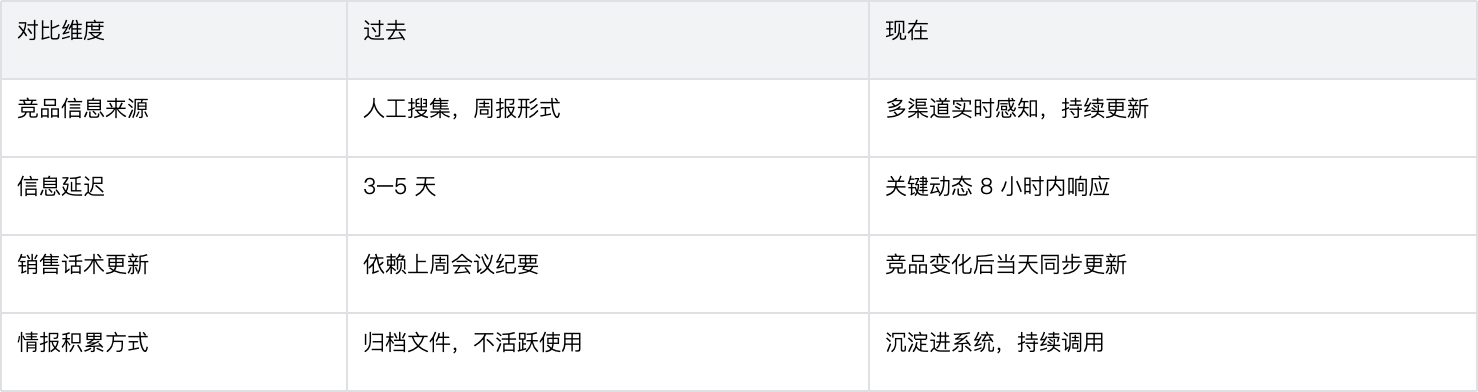
The competitive dynamic response cycle has been compressed from 5 days to within 8 hours, with key nodes such as competitor price drops achieving same-day responses. Sales scripts are adjusted in real-time based on the latest competitive data, and the lead conversion cycle is on average shortened by 1.5 weeks.
Competitive analysis has transformed from a “periodic task” into a “continuously operating perception capability,” which is the core change.
In the past, competitive intelligence was a document that could become outdated; now, it is a system that updates with every action taken by competitors, ensuring that sales always receive the latest judgments. The speed at which a brand responds to market changes no longer depends on how diligent the marketing team is, but rather on how broad the coverage of the system's perception capability is.
This is the core value of the insight research GEA in the competitive monitoring scenario: transforming competitive intelligence from a one-time report into a competitive perception system that enterprises can continuously call upon.
Category
Date
2026-08-12
Read Time
3 min read
Related Recommendations
Global Appliance Brands: How to Build a New Paradigm of 'User Insights'