Design Capacity Reconstruction: The Era of Handcrafted E-commerce Detail Pages is Over, How Can Beauty Brands Break Through Capacity with GEA?
Faced with the challenge of launching 80 new SKU concentratedly and a design capacity gap of over 60%, beauty brands leverage Tezign GEA to integrate brand visual standards and historical high conversion data, generating and adapting multi-channel detail pages in bulk, reducing the production cycle from 16 weeks to 3 weeks.
Category
Date
2026-08-05
Read Time
3 min read
The e-commerce detail pages of beauty brands are an implicit capacity bottleneck, but they are rarely treated as such.
A detail page for one SKU—main image, selling point structure, scenario images, channel variants—typically takes one to two weeks from material to launch. When the number of SKUs is ten, this is acceptable; when the number of SKUs becomes one hundred, the design team's time is completely filled. And during this filled time, most of the work done is repetitive execution, not creative work: changing sizes, adjusting copy positions, adapting to different channel specifications—these tasks are not technically demanding, but each requires human oversight.
A certain beauty brand plans to launch 80 new SKUs in one quarter, with the existing design team's capacity gap exceeding 60%. Hiring more people is not feasible, outsourcing quality is unstable, and the schedule is already packed. They decided to rerun this process using GEA.
Perception (Sense): GEA calls the brand's visual standards and historical high conversion detail page data from the Context System, while identifying the core attributes of each SKU—ingredient characteristics, efficacy categories, target audience profiles, and price positioning. This combination of information determines what this SKU should communicate, how to communicate it, and in what context.
Reasoning (Reason): Based on the DAM multimodal corpus, GEA generates detail page proposals for each SKU—main image composition (automatically coordinating background and lighting effects based on the SKU's main color and brand color scheme), selling point ordering (extracted from product ingredients and efficacy descriptions, sorted by different audience appeal weights, with different selling point structures for 'ingredient enthusiasts' and 'first-time users'), and channel variants (dimensions and layouts for Tmall, JD, Douyin, and Xiaohongshu are automatically adapted, not just scaled, but reorganized according to platform characteristics).
Action (Act): The designer's work shifts from 'designing one by one' to 'reviewing + adjusting the versions generated by GEA'. Focus is concentrated on areas that truly require creative judgment: whether the brand tone is correct, whether the differentiation direction is accurate, and whether the visual expression of a certain SKU distinguishes it from other competitors.
Write Back (Write Back): Each review conclusion and post-release A/B test data are written back to the Context System—what type of composition converts best at which price point, and what type of selling point ordering is most effective on which channel. The generation of the next batch of SKUs is directly optimized based on the performance data of the previous batch.
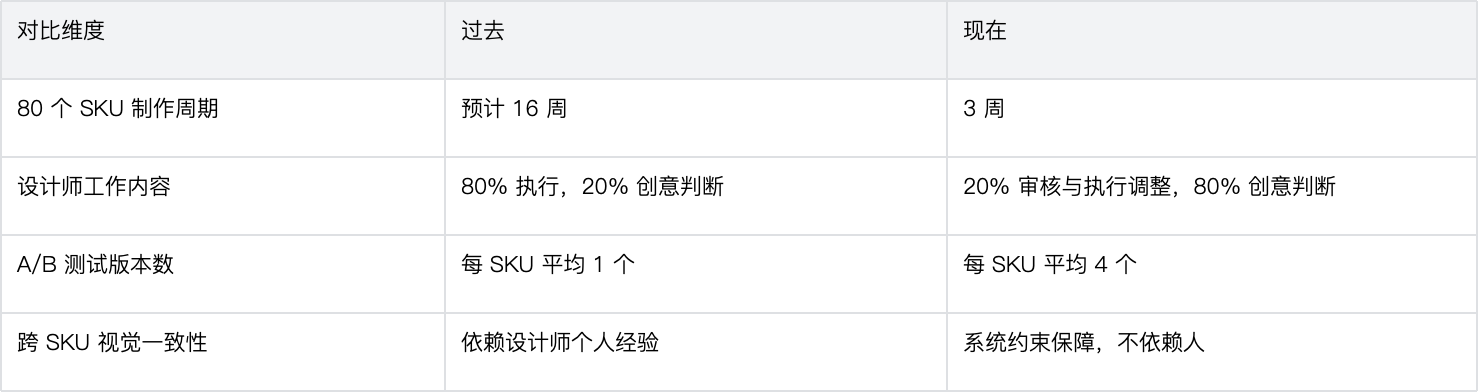
The production cycle for the detail pages of 80 SKUs was compressed from an estimated 16 weeks to 3 weeks. The average number of A/B test variants per SKU increased from 1 to 4, significantly enhancing testing sufficiency.
The time structure of the design team has changed—this is the fundamental change, not just efficiency numbers.
In the past, 80% of the time was spent on execution, and 20% on judgment; after introducing GEA, this has reversed. Output has doubled, and the quality of creativity has actually improved because designers are spending their time on areas that truly require human judgment.
Most people view the capacity issue of beauty detail pages as a matter of 'hiring more designers'. The real solution is to redefine the boundaries of a designer's work: let GEA take on the execution work that can be standardized, allowing the designer's creative judgment to truly shine where it is needed. The value of design creation GEA lies here.
Category
Date
2026-08-05
Read Time
3 min read
Related Recommendations

New Production Capacity Reconstruction: Thousands of Personalized Outputs Online Simultaneously, GEA Enters the Footwear and Apparel Brand Worksite

Design Capacity Reconstruction: How Beauty Brands Use GEA to Compress the Production Cycle of 80 SKUs from 16 Weeks to 3 Weeks
