New Production Capacity Reconstruction: Thousands of Personalized Outputs Online Simultaneously, GEA Enters the Footwear and Apparel Brand Worksite
Footwear and apparel brands leverage GEA to identify SKU characteristics and brand visual standards, generating differentiated main images, models, and scene plans in bulk, which are then refined by designers, resulting in a 3.5 times increase in seasonal main image output efficiency and a 60% reduction in overtime, with a click conversion rate increase of approximately 22%.
Category
Date
2026-08-12
Read Time
3 min read
The seasonal new product pressure for footwear and apparel brands is a cyclical overload issue, not an occasional one.
With hundreds of SKUs each season, main images need to be created, detail pages need to be made, model composites need to be done, and size adaptations for different channels need to be addressed—these tasks are highly repetitive but cannot be fully standardized: each SKU has different colors, fabrics, and silhouettes, leading to variations in corresponding scenes, lighting effects, and compositions. Pure manual work cannot keep up with the volume; pure template work leads to a loss of differentiation, making all SKUs visually appear the same and losing the ability to stand out on the shelf.
A certain footwear and apparel brand saw a 40% increase in the number of new SKUs each season, but the design team's staffing did not change correspondingly. By the end of each season, the design team is in a constant state of overtime, with the lead designers' time completely filled, leaving insufficient time and energy to make judgments on style direction and brand consistency. They decided to run this through GEA again.
Sensing: GEA calls upon the brand's visual tone parameters and historical high-conversion main image data from the Context System while identifying the visual characteristics of each SKU—main color, fabric texture (matte/glossy/textured), silhouette type, and target wearing scenarios (commuting/sports/leisure/formal). These characteristic combinations determine how this SKU should be presented in terms of scene tone.
Reasoning: Based on the MMDiT image generation model, differentiated main image plans are generated for each SKU—scene matching (automatically corresponding wearing scenarios with background environments, matching sports styles with corresponding sports scenes, not using generic studio backgrounds), color coordination (automatically harmonizing the main image color scheme with the product's main color, ensuring the background does not overshadow the product color), model composition (high-quality product and scene composition, adaptable to market requirements with different skin tones and body types). Multiple candidate plans are generated for each SKU, from which designers select and refine.
Action: Designers set the overall style direction for the season (this is the part that requires human judgment), and GEA generates candidate plans in bulk within this style framework, with designers making the final selections and refinements. The consistency of style is controlled by the designers, while the execution volume is handled by GEA.
Write Back: Which types of visual plans have the highest click conversion rates on which types of SKUs, and which scene tones perform best on which channels—these data are accumulated in the Context System, directly optimizing the visual logic for the next season's new products based on the previous season's effectiveness.
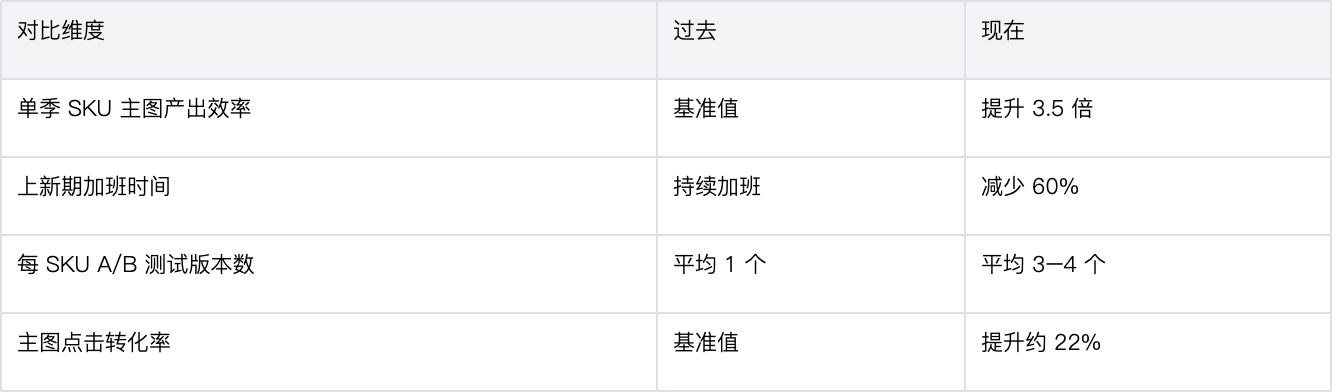
The efficiency of main image output for a single season SKU has increased by 3.5 times, and the design team's overtime during the new product period has decreased by 60%. The number of A/B test versions has increased, and the main image click conversion rate has improved by approximately 22%.
The rhythm of new product launches has shifted from 'capacity determines speed' to 'creativity determines speed.'
This is not a word game. In the past, the number of people in the design team determined how many high-quality visual SKUs could be launched; now, the speed of style direction judgment determines how many can be launched. Once the execution work is handled by GEA, the real bottleneck becomes 'how many quality style judgments can designers make.'
Frequent new product launches and high-quality creativity are no longer mutually exclusive choices. This is the most direct value of design creation GEA in the footwear and apparel scene: allowing the brand's new product speed to no longer be constrained by the team's execution capacity.
Category
Date
2026-08-12
Read Time
3 min read
Related Recommendations
Design Capacity Reconstruction: How Beauty Brands Use GEA to Compress the Production Cycle of 80 SKUs from 16 Weeks to 3 Weeks

Design Capacity Reconstruction: The Era of Handcrafted E-commerce Detail Pages is Over, How Can Beauty Brands Break Through Capacity with GEA?
